

In this newsletter, we shall investigate if the car fleet age could be a limiting factor for transport policy effectiveness, especially relating to fuel and emissions specifications. We will compare developed and less developed economies in Asia and further compare their respective results with the situation in the European Union and in China – referencing them as international benchmarks.
When assessing a country's vehicle fleet, the distribution by fuel composition is a crucial reconsideration. Jurisdictions that actively promote new energy vehicles – such as hybrids and battery-electric models – have an overall substantially younger vehicle fleets than those dependent on conventional fuels. But the effectiveness of fuel and emissions standards will only impact the residual, typically aged, combustion vehicles.
We have also considered the effects of mandated biofuel incorporation on fuel quality and vehicle emissions. Ethanol blends in gasoline have been associated with engine failures and stalling due to valve seat corrosion in vulnerable vehicles. Ethanol raises gasoline vapour pressure, increasing evaporation of volatile organic compounds (VOCs) that contribute to ground-level ozone formation, as reported by Petro Online (16 September 2025). Additionally, phase separation of water in ethanol blends can produce a corrosive water-alcohol layer that impairs engine components, elevates harmful emissions, and poses a risk to groundwater if leaks occur, according to ScienceDirect analyses (29 February 2024). These findings underscore the need for careful assessment of blend ratios, vehicle compatibility, fuel quality standards, and mitigation measures before implementing biofuel mandates.
In this context, on 27 July 2026, Channel News Asia (CNA) published a report under the title: 'Don't push it down our throats': Why India's ethanol-blending fuel policy is facing backlash.
India's decision to rapidly increase the ethanol content of gasoline from 10% to 20%, offering no alternatives, in April 2026 has triggered widespread controversy. The policy, initially scheduled for 2030, was implemented five years earlier than planned.
The CNA report followed social-media posts by motorists showing stalled vehicles and reduced fuel economy. However, experts caution that ageing vehicle components, inadequate maintenance and contaminated petrol may also have contributed to these problems. Other motorists shared videos and images of fuel drained from their tanks, showing visibly separated layers, and alleged that the ethanol blend had damaged their vehicles. So, what is the link between vehicle age and these policies?
Sources: *1 European Commission Passenger Car Fleet Report, published in early 2026; *2 EUROSTAT and ACEA data; *3 China Public Security Statistics; *4 CPCA and CAAM data; *5 Bloomberg; *6 Japan Automobile Manufacturers Association (JAMA); *7 South Korea’s Ministry of Land, Infrastructure and Transport; *8 Environment Health Intelligence New Zealand (EHINZ) data; *9 ISI CEIC data; *10 International Council on Clean Transportation (ICCT); *11 The Jakarta Post; *12 General Statistics Office of Vietnam; *13 Vietnam Automobile Manufacturers Association; *14 Statbase report; *15 VnExpress report citing industry analyses; *16 Society of Indian Automobile Manufacturers (SIAM).
According to the EUROSTAT data and confirmed by the European Automobile Manufacturers' Association (ACEA), approximately 10.6 million new passenger cars were registered in the European Union in 2024, with hybrids rising, battery-only electric stagnating, diesel declining. The breakdown of market shares for new passenger car registrations by powertrain type in 2024 was as follows:
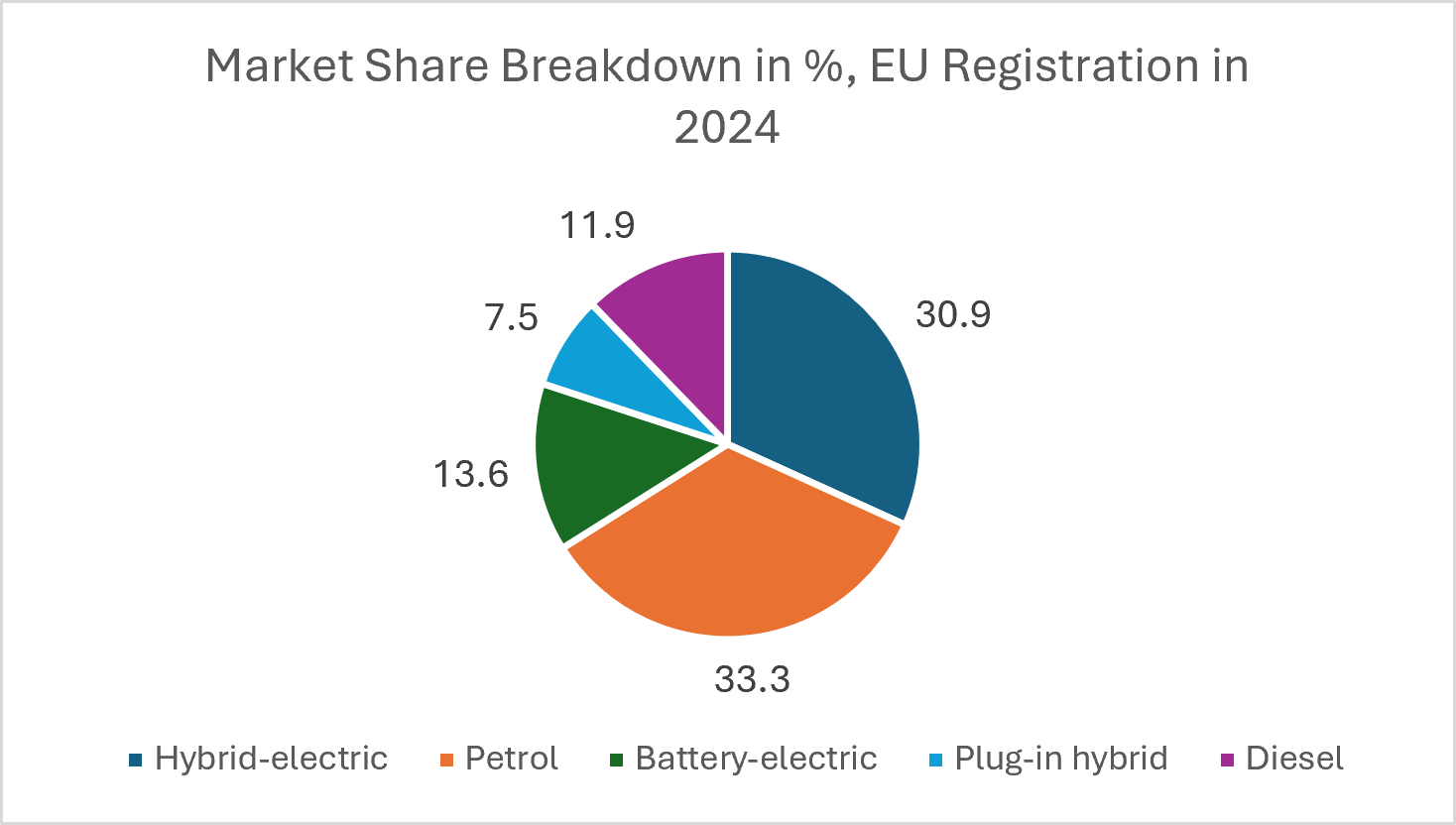
When analysing the age composition of passenger car fleets across European Union member states, a pronounced East-West disparity emerges. Several Eastern member states – particularly Estonia, Romania and Poland – have a notably high proportion of vehicles older than 20 years, each exceeding 35% of their respective fleets. By contrast, Luxembourg records the largest share of very young cars (two years or newer), surpassing 20%, while a broad group of Western European countries falls into a 10-20% range for this cohort.
Since the 1990s, when Euro IV emission standards were introduced, biofuels were also introduced around the same time. Bioethanol blends expanded initially under subsidy and later through policy support; today the common petrol grade is E10, containing up to 10% bioethanol (that meets required sustainability criteria), and is widely available in most member states consistent with EU renewable energy objectives and applied Euro-VI gasoline specification standards.
Exhaust emission and fuel quality standards in the EU were established independently of the age of the vehicle fleet or potential restrictions. To promote environmental policy goals, stricter standards were introduced in which fuel quality and engine requirements were aligned with one another.
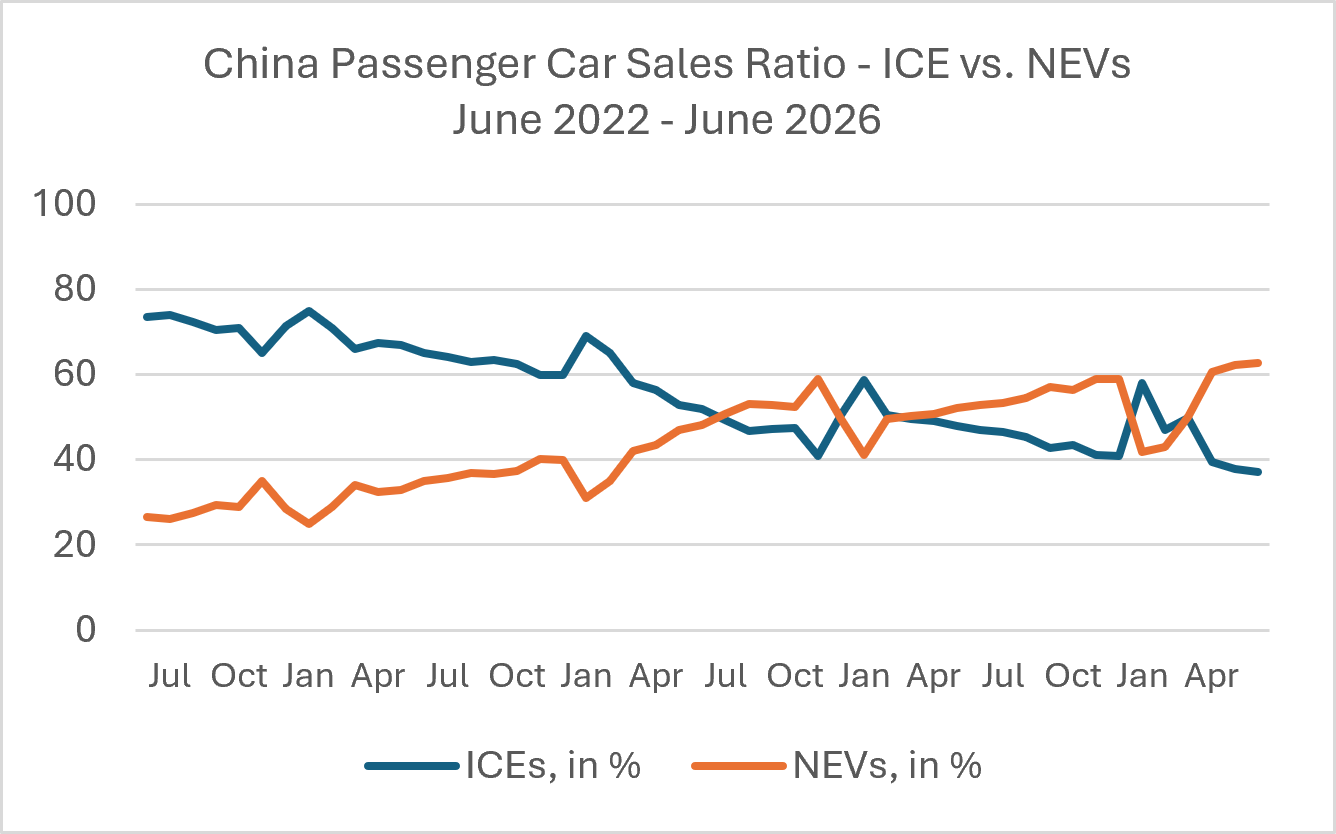
The balance between NEVs and internal combustion engines (ICE) vehicles has shifted rapidly over the last couple of years. NEV registrations frequently exceed 50% of new registrations, reflecting an accelerated transition within the market. The following chart summarises the dynamics and implications for fleet composition and turnover from 2022 till 2026:
Industry data from the China Automobile Dealers Association highlights differences in replacement cycles: ICE vehicle owners generally replace vehicles every six to eight years, whereas NEV owners tend to do so every three to five years. Shorter NEV replacement intervals are driven by rapid technological advancement – particularly in smart cockpit features and automated driving capabilities – along with concerns about battery aging and residual value trajectories.
However, despite the successful implementation of NEVs, China's fuel quality and emission regulatory framework has continued to evolve substantially, aligning progressively with European standards and moving toward implementation of GB-VII standards. This is in recognition that >250 million cars on the roads remain fuelled by gasoline despite high market penetration rates. Initiatives to improve air quality have included the elimination or reduction of leaded gasoline and the incremental adoption of cleaner blending components such as MTBE and alkylate. A planned nationwide E10 ethanol mandate was not implemented as scheduled in 2020 after reports linked ethanol blends to engine failures and corrosion in certain vehicle types; environmental and technical concerns were raised by industry and clean-air advocates. Presently, E10 gasoline is available only in limited volumes, within regions of domestic ethanol production, while fuel quality grades continue to be refined in support of emissions control and air-quality objectives.
As in the EU, fuel quality and emission standards in China were jointly raised to a higher-level maximising effectiveness.
Fleet age in both countries is comparatively low relative to the EU and China. EUROSTAT and Environment Health Intelligence New Zealand (EHINZ) data indicate average passenger car ages of roughly 5.8 years in South Korea and 5.6 years in Japan. By contrast, Taiwan's passenger car fleet is considerably older, with media reports citing an average age near 10.7 years.
Fuel quality and emission standards in South Korea and Japan have advanced significantly over the past two decades and now sit at the top end of international benchmarks. South Korea enforces stringent gasoline quality requirements, including a maximum of sulphur limit of 10ppm and tight controls on benzene and aromatic compounds under the Ministry of Environment, broadly comparable to Euro VI and aligned with aspects of US Tier 3 standards. Japan regulates gasoline quality under the Act on the Quality Control of Gasoline and Other Fuels and Japanese Industrial Standards (JIS K 2202), featuring a 10ppm maximum sulphur limit and minimum octane ratings of 89 for regular and 96 for premium fuels.
Oxygenates have influenced gasoline formulation in both markets: MTBE accounts for approximately 9% of South Korea's gasoline pool, while ETBE averages around 5% of Japanese gasoline. Efforts to introduce direct ethanol blending have largely remained limited to pilot projects and regional initiatives rather than nationwide implementation.
Overall, the parallel progression of fuel quality and vehicle emission standards in South Korea and Japan has contributed to improved air quality and greater fuel efficiency, mirroring trends observed the EU and China. Policy momentum for higher standards continue to drive developments in cleaner fuel technologies across the region.
India's biofuels policy dates to 2003, when a mandate for 5% ethanol blending in gasoline was introduced in select regions. Although early compliance was limited, ethanol use increased over time as part of efforts to reduce import dependence and conserve foreign exchange. Progressive policy steps culminated in phased retail rollout and vehicle-compatibility preparations for E20 gasoline beginning in February 2023. Following regulatory notification by the Ministry of Petroleum and Natural Gas, E20 blended petrol was mandated for nationwide sale effective 1 April 2026.
Policy choices have prioritised ethanol blending over other oxygenates such as MTBE and ETBE, which, despite favourable blending economics and availability, were largely set aside. Today, the government provides incentives to farmers to expand ethanol feedstock production; however, supply constraints persist, stretching agricultural capacity and necessitating some imports for other industrial uses.
Public concern had arisen when non-ethanol grades were completely phased out, offering no alternatives. In the EU, reserve grades continue to be available to complement the diversity of vehicles across different regions/states.
India's experience highlights the importance of coordinating improvements in fuel quality and emission standards with vehicle compatibility, implementation readiness and consumer needs, particularly as the market continues to grow.
Indonesia has long lagged in fuel-quality and emission standards, relying on low-octane Euro IV fuel that may not consistently meet required specifications. However, public awareness of air pollution and its health impacts is increasing.
Indonesia should upgrade its fuel-quality requirements in line with international standards such as Euro V, rather than mandate additional biofuel blends or introduce divergent local standards. Aligning fuel and emissions standards would help renew the vehicle fleet, support decarbonisation, and limit pressure on public finances and consumers.
New energy initiatives could be introduced once appropriate air-quality measures are implemented, particularly in major cities. This would require substantially greater investment in vehicle-replacement subsidies and a comprehensive charging-station network.
Vietnam adopted Euro V fuel-quality and emissions standards in 2022, with wider implementation in 2024. In 2025, it announced plans to phase out fossil fuels, achieve carbon neutrality by 2050, and potentially restrict fossil-fuel vehicles in Hanoi and Ho Chi Minh City from 2026. Key obstacles include high electric-vehicle costs, limited financial support, insufficient charging infrastructure, and the lack of a detailed implementation plan. A mandatory 10% biofuel blend also took effect in June 2026. As improving air quality is urgent, the measures raise concerns about implementation timelines, fleet replacement, consumer affordability, and the limited decarbonisation benefits of biofuel programmes.
Adjusting deadlines and fuel standards to affordable, pragmatic targets would benefit all stakeholders in a country with a relatively young fleet and rapidly expanding electric-vehicle adoption.
The age gap between vehicle fleets in developed and developing countries has narrowed in recent years. This trend reflects tighter emissions regulations, technological advances, and growing adoption of alternative fuels. Nevertheless, the relationship between fleet age and evolving fuel-quality requirements or emissions standards remain complex, with no clear direct correlation established.
A balanced approach to vehicle-fleet renewal is essential, considering fuel quality, emission standards, and the diverse interest of consumers, fuel suppliers, and vehicle manufacturers. Such an approach can ensure that the interests of consumers, fuel suppliers, and vehicle manufacturers are equally safeguarded. Overarching national or international goals can also be pursued in parallel, while security of supply must simultaneously be ensured. Reducing air pollution and protecting human health should remain immediate priorities, alongside the pursuit of long-term decarbonisation. Biofuels should therefore be evaluated carefully on a case-by-case basis, considering their technical performance, environmental impact, sustainability and cost. Where established alternatives – such as ethers rather than ethanol – are available and offer stronger environmental or technical benefits, they should be assessed objectively before policy or market decisions are made. This balanced perspective can help ensure effective, practical, and sustainable progress.